Date: 24 Jan 1999.
Location: Xian Sheng’s house, Taman Melawati
Table of Contents
(A) Is time linear or circular?
Xian Sheng had mentioned in the past that while time is very important to us humans, it is meaningless to Xian Sheng and the Disciples of GOD.
Xian Sheng explained with the following reasons. If we go to a place that has no day or night, we must ask ourselves whether time still matters there.
In a place that has no day or night and is always bright, does time matter?
In a place where day and night are not measured, years are irrelevant, a person stays the same age and never grows old, eating is of no consequence, death is not an option because life is eternal, and you cannot tell whether one day or two have passed, does time matter?
Yet for humans in this world, is time important? Xian Sheng asked whether we know how time flows here. It is important for us to understand this.
Xian Sheng asked the followers what they knew about time, particularly whether it is linear or circular. He also wanted them to explain their reasons for choosing either view.
Sometimes the question seems simple because we do not sit down to think and research it.
When asked what time is, people fall back on the familiar saying that time is money.
Time is precious because we cannot reclaim what has passed, and because we cannot go back to recover it. Time is also money.
(B) What is Time?
There are many questions Xian Sheng would like to ask. For instance, regarding time management, how do people manage their time when they claim that time is precious and time is money? How do they manage it if that is truly the case?
Is time money? What, then, is time? Xian Sheng invited volunteers to share their views on whether time is linear or circular.
Xian Sheng explained that Brother John Yap based his view that time is circular on the Earth’s rotation.
Xian Sheng wishes to hear the explanation from someone who thinks time is linear and progresses in a straight line.
He repeated a follower’s response: time moves forward in a straight line because it cannot go backwards. This demonstrates that some regard time as linear while others perceive it as circular.
Brother John Yap stated that time operates differently in each universe and adheres to the physical laws of that universe. Xian Sheng responded that he is correct, yet the question remains as to whether time is linear or circular.
If we wish to understand time from a humanistic approach, it is important that we understand it from the soul’s perspective.
Xian Sheng used the analogy of a train to explain time. The train travels in a straight line towards its destination and then circles back to the point of departure.
Similar to a train that moves on parallel tracks, we journey along parallel timelines — one for the human body and another for the soul. A person born in 1945 and passing away in 1999 would have lived for 54 years. Time progresses in a straight line for that individual from 1945 until 1999, then halts abruptly as the soul departs the body.
The soul enters a different dimension and follows the timeline there, which differs from the timeline on Earth. Nonetheless, both timelines continue to run parallel to each other. After spending a certain duration in that dimension, the soul returns to rejoin the Earth timeline.
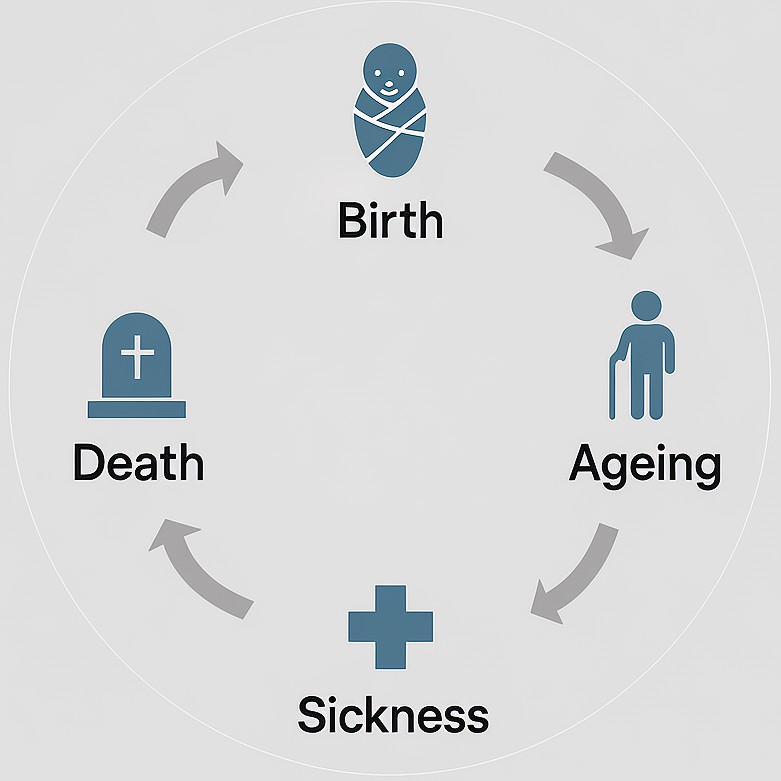
Using the train analogy once more, when the train circles back to its departure station, it begins the journey all over again. Similarly, the soul reincarnates back on Earth as a baby to begin the human journey anew. We say time has completed a full circle for the soul. Here, Xian Sheng clarified that it is not truly a full circle since time cannot move backwards, but should be depicted as a semicircle. The soul’s semicircular timeline rejoins Earth’s linear timeline and both proceed in parallel.
When a person undergoes multiple reincarnations, we can depict their timeline as linear during the years they live on Earth and semicircular when the soul departs to another dimension and later reincarnates back to rejoin the linear timeline. Therefore, the time of the soul and the time of the human body both move in parallel. Xian Sheng asked the followers whether they understood his explanation of how time works for the body and the soul.
Xian Sheng reiterated that while many perceive reincarnation as a full circle, since the soul restarts the cycle as a baby, this is inaccurate from the standpoint of time. Time cannot move backwards but only forwards. Therefore, reincarnation should be regarded as a semicircle within the timeline of the physical universe.

Circle of Life
(C) You must break this Vicious Cycle of Reincarnation.
The reason time is important for our understanding is so that we can plan to break this Vicious Cycle of Reincarnation while we are alive in this world.
The Vicious Cycle of Reincarnation means that humans will keep reincarnating again and again, living endlessly as if time were a circle. This is why we are not wrong to think that time is circular for the soul. Xian Sheng repeated the term Vicious Cycle of Reincarnation three times for emphasis.
If we wish to break free from this vicious and repeating cycle of reincarnation, we would have to think good, see good, hear good, speak good, and do good. Then we will be able to leave this cycle.
We will leave this timeline to exist in a plane where time is neither linear nor circular, but non-existent and no longer essential to us.
This means that time is no longer measured in that plane. Time is neither linear nor circular, as it simply does not exist in this plane—we will have exited from time altogether.
(D) Is Heaven outside of time?
Is Heaven outside the flow of time? Xian Sheng replied that the answer is “Yes”, but that depends on the plane of Heaven.
We may go to a plane of Heaven that is completely outside of the flow of time.
Xian Sheng began by asking the question: if we go to a plane of Heaven where we do not grow old, but then digressed and asked why a person grows old, and replied that it is because of time. It is because time exists that we grow old.
Will we grow old in a plane where time does not exist? If we are at a certain age, we would remain at that age. This means that if we saw an individual who is old, they would remain that old and would never grow older. Xian Sheng asked if the followers understood the concept. If we left time behind, we would remain at the age we were when we left time.
A person who is beautiful would remain just as beautiful for eternity and would never become less beautiful. In fact, everyone is beautiful there.
(E) Guanyin appeared to be 18 years old and beautiful beyond comparison.
A follower asked whether any proof exists for Xian Sheng’s claim that one never grows old in Heaven. Who can corroborate that claim?
Xian Sheng said that Brother Cheong Wai Leong’s mother, who has since passed away, is the proof. She said she saw Guanyin and that she appeared to be 18 years old.
Brother Cheong’s mother said that the idols of Guanyin that people worship cannot compare in beauty to the Guanyin she saw, for her beauty is beyond comparison.
Nevertheless, Brother Cheong’s mother said that her beauty is not what matters here. She said that Guanyin first told her who she was and then told her that praying to the CREATOR is not wrong but entirely right.
Xian Sheng asked for a show of hands from those who had heard Brother Cheong’s mother recount her experience. She had come to address the followers in the past, and Brother Cheong also came and shared his mother’s encounter with Guanyin. Apparently, only two of the followers present had heard of it.
(F) You can choose your gender and age in Heaven.
Some people claimed to have seen Xian Sheng (not physically, but spiritually, such as during meditation). What is the evidence for their claim?
They said Xian Sheng has a very fierce demeanour, with white hair, white eyelashes, and a long white beard—his entire appearance being white.
When asked how old Xian Sheng appeared to them, they replied that he is as old as he is presently—neither a day older nor a day younger. They will remain at their present appearance for all eternity.
Brother John Yap asked why Xian Sheng chose to present himself with an elderly appearance. Xian Sheng replied that it is his personal preference to do so.
Xian Sheng asked them whether they had forgotten that upon passing away, they would be asked to choose their preferred gender and age with which to present themselves. This is a one-time choice—no second chances. They will be granted the beauty and age they desire in Heaven. Once again, Xian Sheng said that beauty in Heaven is beyond any earthly comparison.
In response to a question, Xian Sheng replied that their age does not follow the age at which they passed away on Earth. Once they have made a one-time choice, they will remain as old or as young as they requested.
We are not allowed to choose to be 18 years old upon passing away, then later change it to 20, and then to 26. There is no such option. It is only a one-time choice.
Once again, Xian Sheng asked whether the followers had heard him say this in the past. He said they said they had not heard him because they were not paying attention during his sermons.
(G) Can we reincarnate into the past?
Xian Sheng revisited the earlier question of whether understanding time is important for us. He replied that it is, but added that, regarding time as it pertains to humans, the issue is how we deal with it.
What is time as it pertains to humans? He asked whether understanding time—as it pertains to humans—is important, and replied that it is also important.
Because time exists, history is possible. Hence, some say that time is history.
When asked what time is to some people, some people say, “Time is money.” They are not wrong. Time is both money and history.
If some say that time is politics, they are not wrong. Indeed, it is not wrong to say that time encompasses politics, economy, society, culture, and spirituality.
For human beings, time spans a single lifetime. For the soul, time is eternal. When the soul inhabits a human body, it is confined to just one lifetime of its eternal timeline. This is why each individual carries two timelines: one tied to the body, and one belonging to the soul.
The soul’s timeline is circular because the soul continually reincarnates, each time beginning life anew as a baby. In contrast, the timeline of human existence is linear—time moves steadily forward, even across infinite cycles of reincarnation.
Can the soul reincarnate into the past? Xian Sheng said this is not possible. Reincarnation can only occur in a future time.
(H) How many hours of sleep are sufficient?
When it comes to time, it must be wisely apportioned. There are moments when it is vital for humans to use it effectively.
Xian Sheng asked the followers to reflect on how much sleep they truly need. He chose sleep as an example because, without sufficient sleep, we cannot be alert, attentive, or lucid. Some people would say the longer the better.
Nevertheless, the real question is how we utilise our time—that is what truly matters. So ask yourself: how many hours do you wish to devote to sleep?
Since the followers all called out different answers at once, Xian Sheng found it hard to keep track. He asked them to raise their hands whenever he called out a number—starting with 8 hours and going down to 5. It was clear that people’s sleep needs vary.
Xian Sheng explained that he raised his hand for every option, as he has slept for 5, 6, 7, and even 8 hours at different times. He has tried them all. But if asked what he considers enough, he said 6 hours is enough.
He stated that 6 hours of sleep is enough, irrespective of age. After all, many children do not achieve 8 hours of continuous sleep, as they tend to wake up at night. Once those awake intervals are deducted, their total sleep typically comes to about 6 hours.
However, even for those who sleep 6 hours, are they truly getting 6 hours of actual sleep? If someone wakes three times in the night to urinate, deducting that time, it would be less than 6 hours of sleep, as they would not fall asleep immediately after urinating.
(I) How a three-lane highway can become a two-lane one.
Assuming we sleep for 6 hours, how many hours remain in a day? Xian Sheng worked it out: 24 minus 6 leaves 18. He then asked again and again: What will we do with those 18 hours?
Sister Vera Yap replied that we spend two hours stuck in traffic jams. Xian Sheng responded that the government is to blame—not only for the jams, but for traffic accidents too.
Xian Sheng mentioned that many people died in road accidents during the recent Hari Raya celebrations. There were so many accidents. He asked whose fault it was. He observed that the government never accepts responsibility—instead, it blames motorists’ poor driving, motorcyclists’ recklessness, and even fathers, sons, and mothers, while never pointing the finger at itself.
Xian Sheng offered several suggestions to help reduce traffic accidents. On three-lane highways, station a police officer at a clearly visible spot, holding a camera as if taking photographs.
If the government builds three-lane highways—one for slow traffic, one for general-speed traffic, and one for overtaking—there should be no vehicles in the overtaking lane unless they are actively overtaking another vehicle. That lane must remain empty when no overtaking is taking place. Drivers must return to one of the other two lanes immediately after overtaking. In the general-speed lane, they must travel at 100 km/h or face a penalty. In the slow lane, they must drive below 100 km/h, or they too would be penalised. If this were enforced, fewer people would die on the highways.
We have to treat motorcycles as cars too. They must keep a distance of five car lengths. Similarly, a car must also keep a distance of five car lengths from the motorcycle in front. If this were the case, there would be fewer deaths on the highways. If the government were willing to listen to Xian Sheng’s suggestions, that would be good, as there would be fewer deaths on the highways.
If we asked the government to build an additional lane on a two-lane highway, would the government be willing to comply? It would blame the economic downturn for preventing it from building another lane. However, why didn’t it build a three-lane highway when the economy was not in decline?
Xian Sheng stated that, in reality, the government could have built a three-lane highway using the budget assigned for a two-lane one. He admitted he does not know where the money for that extra lane has gone—and repeated that the existing budget for a two-lane highway is in fact sufficient for three lanes. He simply could not understand where the third lane had disappeared to.
If Xian Sheng were to calculate the highway’s construction budget, his figures would show that it was sufficient to build a three-lane highway. Yet the government built only two lanes—so where did the third lane go? And who would investigate the government’s figures?
Some road sections should be paved three to four inches thick, but were laid with only one inch of asphalt. This has made the roads difficult to traverse, as potholes form after repeated use. If a vehicle hits such a pothole, swerves, and crashes—who is to blame? Did they plan, calculate, and measure accordingly? Apparently, those who paved the roads had cut corners and skimped on materials.
So what do these contractors use their time for—scheming to cut corners and skimp on materials? They use their time to scheme and cheat.
Xian Sheng ended by reminding everyone that time can be used to do good deeds.
(J) Give me two hours of your time to preach.
Suppose we spend six hours sleeping, eight hours working, and two hours stuck in traffic—that’s ten hours accounted for by work-related commitments. After subtracting the six hours for sleep and ten hours for work-related activities, eight hours remain. Xian Sheng asked what the followers do with those remaining eight hours each day.
In response to their answers, Xian Sheng reiterated that time would be used for eating, cooking, washing, going to the market for groceries, dealing with a bit of traffic, and caring for their mothers.
He laughed as he remarked that some people spend time keeping watch over their husbands to stop them from running off with someone new, while others do the same with their wives to prevent them from eloping with a new partner. People fill their time in all sorts of ways. Xian Sheng advised them not to waste time monitoring their spouses, but instead to let them do as they please. Keeping an open mind, he said, helps one avoid unnecessary headaches and troubles.
Joking aside, what Xian Sheng urges the followers to focus their time on is preaching Baitiangong. They may visit their Baitiangong brothers and sisters to talk, discuss, or even debate with them—activities that deepen their spiritual understanding. They can also read the Anniversary books.
Xian Sheng asks each follower to dedicate just two hours of their day to preaching Baitiangong to friends. Out of the 24 hours in a day, he requests that they set aside those two hours specifically for preaching activities.
They might alternate between two hours spent reading Baitiangong books and two hours devoted to preaching Baitiangong. Xian Sheng remarked that he is not asking for much of their time.
He acknowledges that some followers already devote one day a week to visiting the homes of their Baitiangong brothers and sisters.
He suggested they bring their friends to the Friday night spiritual discussion—to help them increase their awareness of Baitiangong, or to discuss or even debate it with them. Ultimately, he asks them to set aside some time to invite their friends over.
(K) Welcome former Baitiangong followers to join the spiritual discussions.
Besides reaching out to friends, Xian Sheng urged us to seek out former Baitiangong followers—those who were with us in the early days but whom we have not seen since—and invite them back to take part in our spiritual discussions.
He reiterated that we should visit the homes of these former Baitiangong followers to chat with them, and encouraged them to come to Xian Sheng’s house on Friday night—to listen to the “big comedian” (Xian Sheng’s own humble way of referring to himself) tell stories and share a good laugh.
If we can’t get them to attend four times a month, twice would be good enough.
Xian Sheng advised the followers to tell them, “We often forget what Xian Sheng has said ourselves—so it’s always good to listen again.”
He also urged a group to reach out to these former followers and invite them to the Friday night spiritual discussion to deepen their understanding.
(L) Do you need to buy groceries every day?
Xian Sheng urged the followers to make good use of those eight hours. After all, it hardly makes sense to go to the market every day for groceries. As people might say, “For goodness’ sake—just do your shopping once a week and store everything in the fridge!”
Don’t buy a little now and leave the rest for later. Instead, take a moment to sit down and list everything you need for the week—then store it all in the fridge. Be sure to note each item (beef, pork, chicken, duck), its weight in catties (1 catty = 605 grams), and the day you plan to cook it.
This way, there’s no need to go to the market every day. We should plan our time wisely—by avoiding daily trips and instead buying groceries in one go, then storing them in the fridge.
Similarly, if you plan to buy canned foods, take a moment on Sunday morning to list everything you need and purchase a full week’s worth of groceries. There’s no need to shop every day.
Don’t make all kinds of excuses just to go grocery shopping. Some people head out to buy groceries and disappear for the entire day. When asked what happened, they just laugh and say they popped in for a game of mahjong.
Xian Sheng said it was based on a true story. He explained that an unnamed individual went out on a Sunday, and when Xian Sheng asked where he’d been all that time, he replied that he’d gone to play Chinese checkers.
Some prefer to watch others play Chinese checkers instead of playing the game themselves. They derive pleasure from watching others play Chinese checkers or mahjong. They disappeared for the whole day on the excuse of buying groceries.
Once more, Xian Sheng asked whether it is important to utilise our time properly.
(M) Time is not something we can control at will.
It is important to set aside some time for our hobbies.
Xian Sheng explained that he was very keen to pursue his hobby today. He told them to look at his trousers and shirt, which he had been wearing since that morning.
When he got up this morning and finished dressing, he placed his socks next to the shoe rack on the car porch, ready to put them on. He looked up at the grey skies, stretched out his hands, and felt raindrops on his palm. He was disappointed—he had dressed for a day out on his Harley, but the rain persisted all day. It wasn’t heavy or light; it just kept drizzling steadily the whole day.
It had been drizzling since morning until meditation time, yet it never actually rained. He had wanted to ride his Harley since the morning and waited all this time, but in the end, he couldn’t.
Sometimes, time is not ours to use as we please. For example, Xian Sheng was fully dressed and ready to go out riding on his Harley—but in the end, he couldn’t go. This is because time is not something we can control at will.
(N) Set aside time for our personal interests.
Regardless, we need to set aside time for our personal interests.
If we feel the need to set aside time to eat our favourite food, then we should buy it and eat it. For example, yesterday Xian Sheng said he felt like eating sardines, even though rice had already been prepared. When he got home from work, he saw bread and suddenly wanted sardines in bread. He immediately drove to the shop, bought three cans of sardines, went home, sliced the bread, filled it with sardines, and ate it instead of rice. He explained that when he felt a desire to eat something that interested him, he simply acted on it.
Xian Sheng explained that we need to set aside some time for ourselves to do things that please us. However, he advised us not to engage in vices or in activities that are immoral, deviant, unethical, illicit, or sinful. There are people who enjoy such activities, but they will regret them later.
Xian Sheng advises us to do things that please us. If someone enjoys playing mahjong, they should go ahead and play. Xian Sheng joked that he himself loves mahjong—but after a while, no one was willing to play with him. They told him straight out they refused, because he tends to win most of the time. He said he now needs to find new mahjong buddies, adding that as much as he loves the game, he can’t play it alone.
Sometimes, we cannot do what we like because of certain circumstances, and not because we have not properly utilised our time.
(O) Two hours for Baitiangong activities.
It is important to plan how to use our time. That is why Xian Sheng suggested buying all our groceries in one go.
We spend so much of our time working each day. Xian Sheng asks us to set aside some time to preach Baitiangong. He said that no matter what work we do, please set aside just two hours—a small amount of time—to take part in Baitiangong activities or to preach Baitiangong.
If that were the case, Baitiangong’s growth would be truly remarkable. It doesn’t require much time—just two hours a day.
Perhaps we could read Baitiangong articles aloud to a group of children.
(P) Parents should set aside time to play with their children.
Regarding time, Xian Sheng asked the followers who have children whether they set aside time to play with them. He asked several times for their responses.
However, Xian Sheng observed that many do not set aside time to play with their children. He said he truly does not understand why.
Xian Sheng said that he sets aside time to play with his children. His son, Brother Chew Pit Tian, watched the NBA (National Basketball Association) show and told Xian Sheng that he would like to play basketball.
Since his son likes playing basketball, he asked Brother Wong Kam Poh to buy a basketball hoop with a backboard and have it mounted on the car porch. He asked whether any of the followers had seen it.
This morning, Xian Sheng played basketball with his son, practising passing and dribbling. He would pass the ball and shoot it into the hoop, then let his son pass it back. They took turns dribbling and passing the ball between them.
Xian Sheng advised parents to set aside time to play with their children. If a child develops an interest in basketball at a young age and becomes skilled at shooting into the hoop, the height of the hoop should be gradually raised as they grow older.
Xian Sheng suggested building a basketball court in the meditation area. Brother Kian said there wasn’t enough space. After some discussion, Xian Sheng proposed flattening the area and laying a cement floor. They could sit on the cement for meditation—and when it’s not being used for that purpose, the same space could serve as a basketball court.
He added that the area is long enough for a tennis court—they would simply start from the corner and extend all the way to the fence. The ground would need to be raised, and a back wall built.
Although Brother Kian said it wasn’t possible, Xian Sheng insisted it is possible—and that the only question is whether we truly want to do it.
(Q) Listen to geopolitical news, as we must know and learn.
When it comes to Xian Sheng’s interest in Astro-related channels, he watches only four: National Geographic, CNN, CNBC, and Discovery. These are the only channels he watches—and he makes a point of watching them regularly.
Sometimes he doesn’t watch the TV, but turns up the volume when he goes to the toilet so he can listen to the audio.
He can listen to the news—for example, updates on Europe’s economic situation. We must listen, we must know, and we must learn.
(R) Do not waste the 8 hours. Learn something or participate in activities.
Xian Sheng urges parents to encourage their children to learn the lion dance. He has long wanted to include it as part of Baitiangong activities.
There is a group that takes part in the lion dance. However, Xian Sheng said it is still short of members, and he asked them to recruit a few more.
Xian Sheng also encourages the elderly to participate by playing traditional Chinese musical instruments. A follower remarked that the children need to study for their exams. Xian Sheng acknowledged this and asked the elderly to step forward and participate, as it is good for them.
He explained that last night he sang and played his guitar. Sometimes it helps to ease boredom. He played and sang until close to midnight, continuing until he felt tired and went to sleep. He once had a personal tutor to teach him guitar.
He encourages everyone to learn something—no matter what it is, so long as they are learning.
They could take up interests such as painting — French painting, handicrafts, baking cakes, or anything that interests them.
The key point Xian Sheng wanted to emphasise is this: we must not waste the eight hours left to us each day.
Otherwise, use the time to read—especially the Baitiangong Anniversary books. Doing so will deepen our understanding and strengthen our ability to preach, which is of great importance to us.
(S) Please do not reincarnate as humans anymore.
Xian Sheng said that we should know by now: time has no meaning for the deceased or in Nothing. In those dimensions, time is irrelevant.
Time in the human dimension carries historical significance. However, many historical timelines are incorrectly dated due to wrong calculations.
It drifted by either six or seven years. Xian Sheng once carried out a calculation for the followers on this, but he cannot recall the exact details now. To correct history now by readjusting the time is very complicated.
Xian Sheng urged the followers to deepen their understanding of how time works and to use it fully in their lives.
Xian Sheng reminded the followers that the most important thing is to break free from the time-bound Vicious Cycle of Reincarnation and go to a dimension beyond this time loop.
He told them not to be reincarnated as humans again—to make this their one and final cycle.
(T) GOD willing, time travel will be possible for humans, but by spiritual means.
Brother John Yap asked whether we could travel back in time, as in the TV series Quantum Leap. Xian Sheng rephrased the question and opened it to the floor.
When it comes to the CREATOR, nothing is impossible. But can an ordinary human being travel back in time? In films, people can move forwards and backwards through time—but these are only fictional stories.
If GOD permits humans to travel backwards and forwards in time, would that be possible then? Xian Sheng replied, “Yes—because nothing is impossible for the CREATOR.”
But as far as human capability is concerned, time travel is not possible. It exists only in cinema and television—such as the TV series Quantum Leap—and remains purely fictional, not practical.
Brother John Yap referred to the 1984 film The Philadelphia Experiment, which depicts time travel. Xian Sheng acknowledged that experiments were conducted, but clarified that the claim that they achieved time travel is untrue—it never happened in reality.1
Xian Sheng pointed out that the movie depicts the ship entering a certain magnetic field.2
Xian Sheng recalled a personal experience in which he saw, in a vision of the future, a lottery number published in a newspaper before its actual release. When he woke up, he could not remember all three numbers—only the third one. He bought that number and won. He remembered that he had told the followers, even during a meditation session.
Once again, Xian Sheng reiterated that if GOD wills it, nothing is impossible. But when it comes to human beings’ ability to travel through time, as in the TV series Quantum Leap, it is not possible now, nor will it be possible in the near future.
Nevertheless, if GOD wills it, humans can go back in time and move ahead in time—but by spiritual means.
But for ordinary humans, time travel is not possible. What the TV series Quantum Leap depicts is only a theory and has not been put into practice.
Xian Sheng explained that time travel remains at a theoretical stage, much like many psychological theories, which have not yet been put into practice.
Xian Sheng said that although time travel theories cannot be put into practice, people can keep on trying.
(U) Humans just cannot possibly travel back in time.
In response to Brother John Yap’s question about whether humans can travel backwards or forwards in time, Xian Sheng replied, “Not possible!”
The past is the past—how can humans travel back in time? We belong in the present.
Earlier, Xian Sheng explained that time flows linearly during human life, and he traced a straight line with his finger to illustrate this. When we die, the soul departs and drops out of that linear timeline, entering another dimension—shown by Xian Sheng as a half-circle. Later, the soul re-enters the linear flow of time as a reincarnated human.
According to this understanding, for a human to travel back in time, the soul would need to retrace its path—moving backwards along the same half-circle it took when leaving the linear timeline—before reincarnating here. This dual-path structure—the straight line while embodied on Earth and the half-circle while in another dimension—is essential to understanding the impossibility of physical time travel. Humans cannot arbitrarily jump to any point in the linear timeline because the soul was not present on that timeline during the periods it spent in the other dimensions. Nevertheless, Xian Sheng reiterated: if GOD wills it, anything is possible.
He explained that he saw the lottery number because he had asked for it. Xian Sheng wanted to know about time, so he asked GOD, and the knowledge was revealed to him.
He mentioned that he once meditated in his room. When he opened his eyes, the room contained nothing—no windows, no door, nothing at all—only white. He asked the followers whether they remembered this incident, as he had shared it with them before.
When it comes to the spiritual realm, it is possible for our soul to leave linear time. We meditate and ask GOD to grant us the experience of leaving time. (However, this is not possible with the physical body.)
In Baitiangong, nothing is impossible—but only through meditation. Xian Sheng told us that during meditation, we can ask GOD to grant us a deeper understanding of time.
- The Philadelphia Experiment is an alleged secret military experiment that supposedly took place in 1943 at the Philadelphia Naval Shipyard. According to the conspiracy theory, the U.S. Navy tested a device that rendered the USS Eldridge, a destroyer escort, completely invisible and caused it to teleport.
- As the Philadelphia Experiment legend goes, the USS Eldridge was surrounded by an extraordinarily strong electromagnetic field created by massive generators mounted on the ship. The claimed objective was to warp light itself around the hull, rendering the entire vessel completely invisible—both to radar and to human sight.